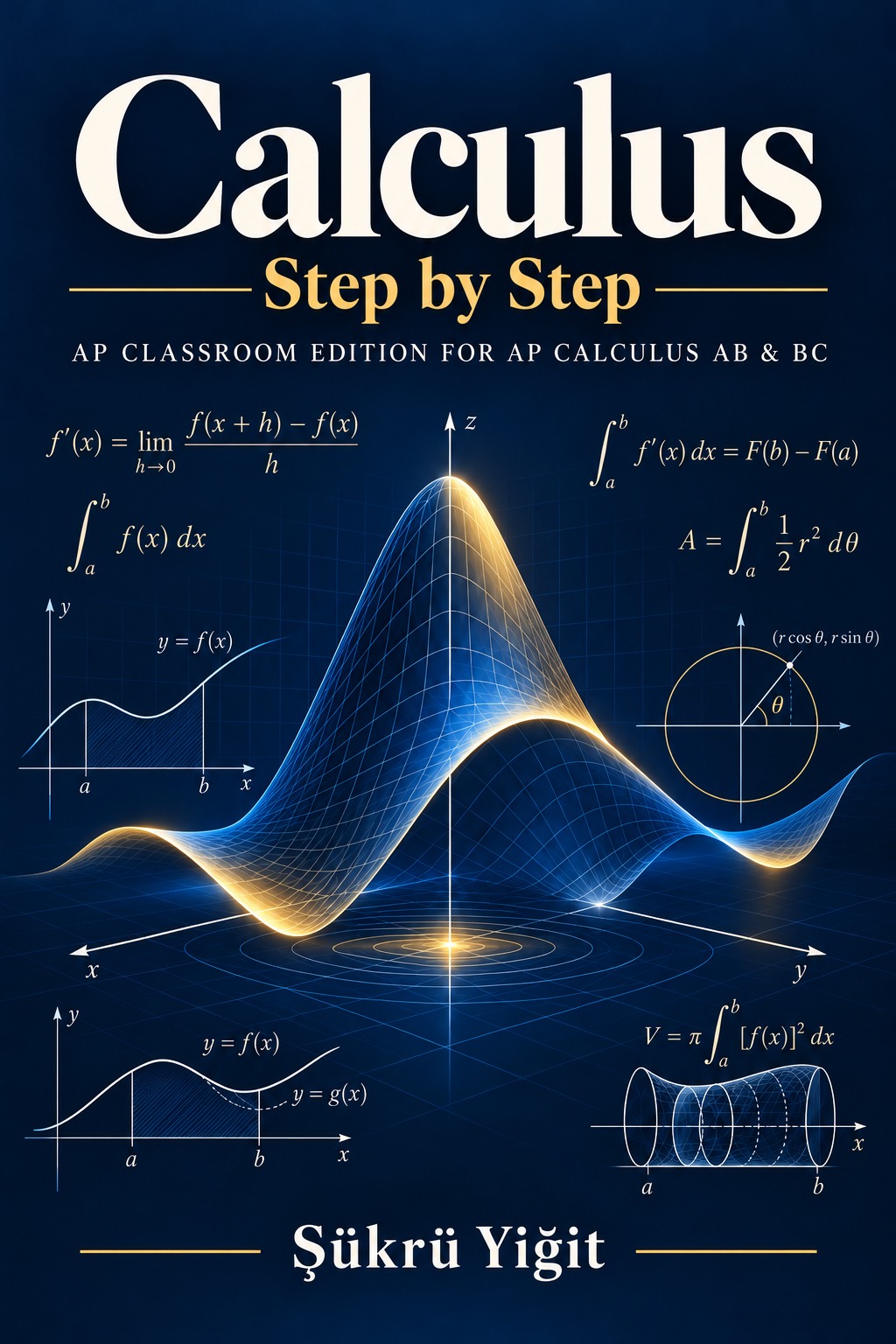
Sample · 00-Fundamentals
Chapter 1 Overview
VerityPrep-AP-Calculus-Light-Chapter-00-Fundamentals
Calculus is built on algebra, functions and trigonometry. Most difficulties in a calculus class are not really calculus difficulties: they come from a fraction that was added wrongly, an exponent law that was forgotten, or a sine value that was not remembered. This chapter collects the fundamentals that the rest of the book uses every day: inequalities and absolute value, exponents and factoring, rational expressions and equations, functions and their graphs, lines and slope, polynomial and rational functions, composite and inverse functions, exponentials and logarithms, and trigonometry. It is not part of the AP Calculus CED; it is a VerityPrep foundation chapter for AB and BC students. Every topic explains the ideas step by step, starts each Part with easy Honey Badger warm-up questions, and has a Real-Life Application box and a Career Investigation box. The chapter ends with two mixed review sets, Revision (Calc Not Allowed) and Revision (Calc Allowed), each with multiple-choice questions and a 9-point free-response question.
🎓 Where This Chapter Can Take You
Mira wanted to study engineering, but the first calculus lesson felt like a foreign language. Her teacher asked her to simplify \( \dfrac{x^2-4}{x-2} \), and she realized the problem was not the new ideas but the old ones. After two weeks of practising fundamentals, the calculus examples suddenly made sense: each new step used tools she already owned.
That is the purpose of this chapter: to make sure every tool is sharp before the climb begins. The people below use these same tools every working day. Which row will be yours?
| Career | What they do | Topics used | Example university programs |
|---|---|---|---|
| Quality control engineer | keeps parts within tolerance using absolute value | 0.1 | Industrial Engineering, Istanbul Technical University; Manufacturing Engineering, University of Michigan |
| Data storage engineer | sizes storage in powers of two | 0.2 | Computer Engineering, Bogazici University; Computer Science, University of Waterloo |
| Electrical engineer | adds fractions to find resistances | 0.3 | Electrical and Electronics Engineering, METU; Electrical Engineering, Imperial College London |
| Logistics pricing analyst | writes price rules as piecewise functions | 0.4 | Industrial Engineering, Koc University; Supply Chain Management, MIT |
| Motion graphics designer | moves and stretches curves with transformations | 0.5 | Animation, Bilkent University; Motion Design, Savannah College of Art and Design |
| Civil engineer | designs road grades as slopes | 0.6 | Civil Engineering, Istanbul Technical University; Civil Engineering, TU Delft |
| Packaging engineer | models box volumes with polynomials | 0.7 | Mechanical Engineering, Sabanci University; Packaging Engineering, Michigan State University |
| Cybersecurity analyst | encodes and decodes with inverse functions | 0.8 | Computer Engineering, Hacettepe University; Information Security, Royal Holloway University of London |
| Seismologist | measures earthquakes on a logarithmic scale | 0.9 | Geophysical Engineering, Istanbul Technical University; Geophysics, Caltech |
| Wind turbine engineer | models turning blades with sine and cosine | 0.10 | Energy Systems Engineering, Izmir Institute of Technology; Wind Energy, DTU Denmark |
| Land surveyor | turns measured ratios into angles | 0.11 | Geomatics Engineering, Yildiz Technical University; Geomatics, University College London |
🤖 The Future of Work - Calculus in an AI World
Continue reading — 11 chapters, worked examples and practice.
Sign in to buy